
Disposable pet training pads are designed to absorb urine and help protect floors, furniture, and other indoor surfaces. However, not every pad performs equally well under real-use conditions. Leakage can occur even when a product appears thick or contains a highly absorbent core.
For pet brands, importers, wholesalers, and distributors, understanding the causes of leakage is essential when evaluating product quality. A pad that absorbs liquid quickly but fails to retain it or protect the floor can lead to customer complaints, returns, and damage to brand reputation.
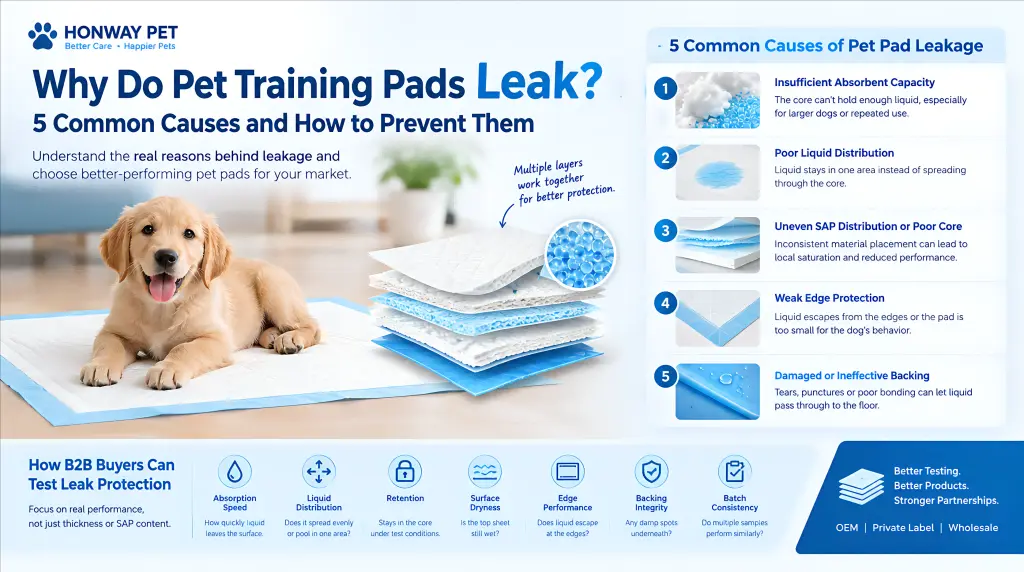
In most cases, leakage is related to one or more factors: insufficient absorbent capacity, uneven liquid distribution, poor core construction, weak edge protection, or an ineffective waterproof backing.
This guide explains five common causes of pet training pad leakage and outlines practical ways buyers can evaluate leak protection before placing a bulk order.
Quick Summary
Pet training pads may leak because the absorbent core cannot handle the liquid volume, liquid accumulates in one area, the core loses its structural integrity, urine escapes through the edges, or the waterproof backing is damaged or defective.
When comparing disposable pet pads, buyers should evaluate absorption speed, liquid retention, surface dryness, edge construction, backing integrity, and performance under realistic use conditions. Product thickness or SAP content alone cannot guarantee leak-proof performance.
1. Insufficient Absorbent Capacity
One of the most common reasons for leakage is that a pad cannot retain the amount of liquid deposited on it.
The absorbent capacity depends on several factors, including the amount and distribution of super absorbent polymer (SAP), fluff pulp content, core dimensions, and overall product construction. A pad may perform adequately for a small puppy but struggle with a larger dog or repeated use.
What causes the problem?
- The absorbent core is too small for the intended application.
- The SAP and fluff pulp combination does not provide sufficient retention.
- The pad is used repeatedly beyond its intended capacity.
- The product specification does not match the target dog’s size or usage frequency.
Adding more SAP does not automatically solve the problem. SAP needs to be distributed appropriately within the core, and the complete structure must allow liquid to reach the absorbent materials.
How can buyers reduce the risk?
When evaluating samples, consider the intended application, recommended replacement frequency, pad dimensions, and absorbency performance. Test products using consistent liquid volumes and application methods so that different samples can be compared fairly.
For B2B buyers, the goal is to select a pad that matches its intended market rather than simply choosing the product with the highest advertised absorbency.
2. Poor Liquid Distribution
A pad may have enough total absorbent material but still leak if liquid remains concentrated in one area.
When urine is deposited quickly, the surface and acquisition layers need to transfer it into the absorbent core. If liquid spreads too slowly or the core absorbs unevenly, a saturated spot can develop before the surrounding material is fully used.
This can cause liquid to pool on the surface, run toward an edge, or pass through the pad before the absorbent materials can retain it.
Signs of poor liquid distribution
- Liquid remains on the surface longer than expected.
- One small area becomes saturated while other areas remain dry.
- Urine spreads toward the pad’s edges.
- Performance declines when liquid is deposited repeatedly in the same location.
How to evaluate distribution performance
Apply a measured amount of test liquid to a consistent location on each sample. Observe how quickly the liquid disappears from the surface and whether it spreads through the absorbent area.
Repeat the test at different locations, including the center and areas closer to the edges. This helps reveal whether the product performs consistently across its usable surface.
A fast-drying top sheet is useful, but it should work together with effective liquid distribution and retention.
3. Uneven SAP Distribution or Poor Core Construction
Super absorbent polymer helps capture and retain liquid, while fluff pulp supports absorption and distribution. However, the performance of the absorbent core depends on how these materials are combined and positioned.
If SAP is unevenly distributed, certain areas may retain liquid effectively while others become saturated quickly. Poor core formation or insufficient structural stability can also reduce the consistency of the finished pad.
Why does core consistency matter?
A disposable pet training pad is a multi-material product. Its absorbent components must work together rather than function as isolated materials.
Potential problems include:
- Uneven distribution of absorbent materials.
- Localized thin spots in the core.
- Poor bonding or inadequate core stability.
- Material shifting during handling or use.
- Differences between samples or production batches.
These issues can be difficult to identify by looking at a pad’s exterior alone.
What should buyers check?
Inspect several samples from the same batch rather than relying on one piece. Compare core thickness and distribution, check for obvious thin areas, and conduct repeated absorption tests.
For larger orders, buyers should also ask suppliers how they control material feeding, core formation, and finished-product consistency during production.
4. Weak Edge Protection or Incorrect Pad Placement
Not every leak means that liquid has passed through the absorbent core or waterproof backing. Sometimes urine travels beyond the pad’s usable area.
This can happen when a dog urinates close to an edge, when liquid spreads rapidly across the surface, or when the pad is too small for the dog’s behavior and body size.
Construction can also affect edge performance. Uneven core placement or inconsistent sealing may leave some areas more vulnerable than others.
Common contributing factors
- The pad is too small for the dog’s normal elimination pattern.
- Liquid is deposited near a corner or edge.
- The absorbent core is positioned unevenly.
- The pad shifts during use.
- The dog steps on or folds the pad, exposing the floor.
How to prevent edge-related leakage
Choose a pad size that provides adequate coverage for the intended dog and usage area. For dogs that move around frequently, a larger pad or a product with adhesive tabs may help keep the pad in position, depending on the design.
During sample evaluation, test liquid application at multiple positions rather than only in the center. Observe whether the liquid remains within the pad and whether the edges maintain their shape.
For manufacturers and private-label buyers, consistent core placement and reliable edge construction should be included in product quality checks.
5. Damaged or Ineffective Waterproof Backing
The waterproof backing is the barrier that helps prevent absorbed liquid from reaching the floor. Many disposable pet training pads use a polyethylene (PE) film backing for this purpose.
If the backing is punctured, torn, poorly bonded, or otherwise defective, liquid may escape even when the absorbent core performs well.
What can compromise the backing?
- Film damage during manufacturing or converting.
- Tears or punctures during packing, transport, or handling.
- Inconsistent material quality.
- Poor bonding between layers.
- Defects that are not detected during finished-product inspection.
The appearance of the backing alone cannot confirm its integrity. A film may look normal but still contain a small defect that allows liquid to pass through.
How should buyers test the backing?
Place a sample on a clean, dry surface and apply a controlled amount of test liquid. After the specified observation period, inspect the underside of the pad and the surface beneath it.
Check for damp spots, visible damage, or liquid penetration. Repeat the test across several samples and different production batches when possible.
Buyers should also confirm that the backing remains intact during normal folding, packaging, and handling.
How B2B Buyers Can Test Pet Pad Leak Protection
A consistent sample-testing procedure makes it easier to compare suppliers and identify performance differences before committing to a bulk order.
The following checks can be incorporated into a basic incoming-sample evaluation.
| Test item | What to observe | Why it matters |
|---|---|---|
| Absorption speed | How quickly liquid leaves the surface | Helps assess initial liquid uptake |
| Liquid distribution | Whether liquid spreads through the core or pools in one area | Reveals localized saturation risks |
| Retention | Whether absorbed liquid remains within the core under the chosen test conditions | Helps assess liquid-holding performance |
| Surface dryness | Whether the top sheet remains excessively wet after absorption | Supports a better user experience |
| Edge performance | Whether liquid escapes when applied near different edges | Identifies edge-related leakage |
| Backing integrity | Whether the underside or test surface becomes damp | Checks the waterproof barrier |
| Batch consistency | Whether multiple samples perform similarly | Helps assess manufacturing consistency |
For meaningful comparisons, keep the test conditions consistent. Use the same liquid type, measured volume, application location, observation time, and sample size wherever possible.
Avoid comparing one supplier’s sample under favorable conditions with another supplier’s sample under different conditions. For formal quality approval, buyers should agree on measurable acceptance criteria with the manufacturer before testing.
Why Thickness Alone Does Not Guarantee Leak Protection
A thicker pet training pad is not necessarily more reliable than a thinner one.
Thickness may reflect the amount of fluff pulp, the structure of the core, or other materials. It does not independently establish absorption speed, liquid retention, edge performance, or waterproof backing quality.
Similarly, a higher advertised SAP content does not guarantee that liquid will distribute evenly or that the backing will remain intact.
When comparing products, buyers should evaluate the complete construction and test actual performance. A well-balanced pad should combine suitable absorbent materials, effective liquid distribution, a stable core, adequate coverage, and a reliable waterproof backing.
The appropriate specification will depend on the target market, dog size, expected usage, retail positioning, and price requirements.
What Should Buyers Ask a Pet Pad Manufacturer?
Before confirming a wholesale or private-label order, buyers can ask the manufacturer the following questions:
- What absorbent materials and backing materials are used?
- Which pad sizes and absorbency specifications are available?
- How is the absorbent core formed and checked for consistency?
- What inspections are performed on the waterproof backing?
- How does the factory evaluate finished-pad absorption and leakage?
- Can samples be supplied for testing before mass production?
- What quality criteria are used for bulk orders?
- Can the manufacturer customize dimensions, packaging, or other product specifications?
The answers should be supported by clear product specifications and, where appropriate, sample test results or quality-control records.
For OEM and private-label projects, it is especially important to confirm the approved sample and agreed specifications before production. Any changes to materials, dimensions, or construction should be reviewed rather than assumed to be equivalent.
Frequently Asked Questions
Why do puppy pads leak even when they are new?
A new pad may leak because of insufficient absorbent capacity, uneven liquid distribution, a damaged waterproof backing, or liquid escaping over the edge. Pad size and placement can also contribute. Testing several samples helps distinguish a product defect from a usage issue.
Does more SAP mean a pet pad will not leak?
No. SAP helps retain liquid, but performance also depends on material distribution, the absorbent core, liquid transfer, pad dimensions, edge construction, and the waterproof backing. The complete product should be evaluated.
Can a pet training pad leak through the bottom?
Yes. If the PE backing is torn, punctured, or defective, liquid can reach the surface underneath. A controlled underside inspection is a useful part of sample testing.
How can wholesalers compare the leak protection of different pet pads?
Use the same test conditions for each sample. Compare absorption speed, distribution, retention, edge performance, backing integrity, and consistency across multiple pieces. Agree on acceptance criteria before approving a large order.
What should private-label buyers prioritize when sourcing leak-proof pet pads?
Buyers should confirm the intended application, dimensions, absorbency requirements, material specifications, backing integrity, packaging, and quality-control procedures. They should also test and approve a production-representative sample before placing a bulk order.
Final Thoughts
Leakage in disposable pet training pads is rarely explained by one specification alone. Absorbent capacity, liquid distribution, core construction, edge protection, and waterproof backing all contribute to the finished product’s performance.
For pet brands, importers, wholesalers, and distributors, a structured sample-evaluation process is one of the most practical ways to reduce sourcing risk. It helps buyers compare products on measurable performance rather than relying solely on thickness, appearance, or advertised material content.
At Honway Pet, we supply disposable pet training pads for pet brands, wholesalers, and distributors, with options for wholesale, OEM, and private-label projects.
Explore our disposable pet training pads or contact our team to discuss product specifications and customization requirements.
Website: https://www.honwaypet.com/
Email: export@honwaypet.com