
OEM Pet Pads: A Complete Customization Guide for Global Buyers
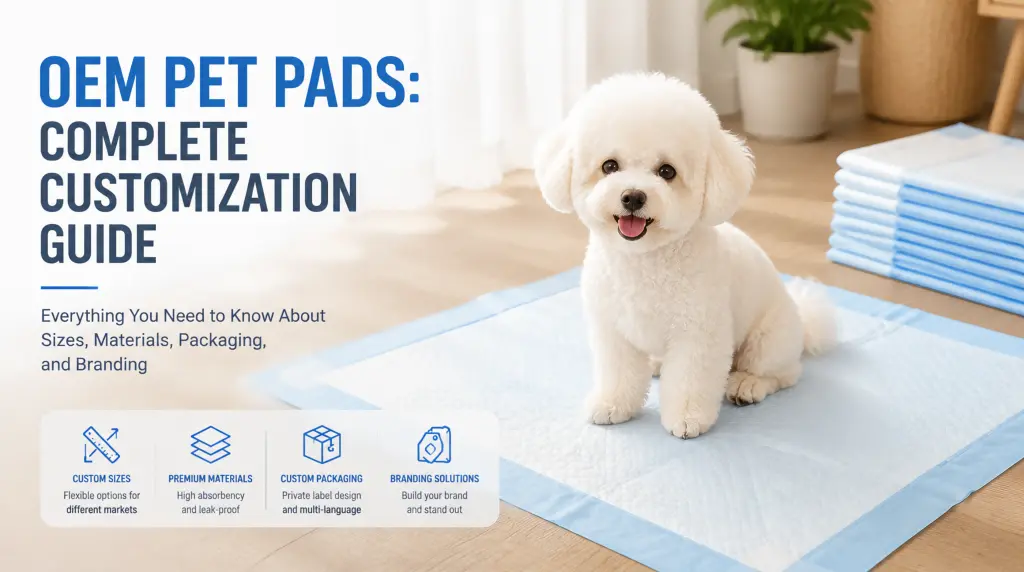
In the global pet care market, OEM pet pads have become one of the fastest-growing product categories for private label brands, Amazon sellers, and distributors. As competition intensifies, more buyers are no longer just looking for standard products—they want customized solutions that match their brand positioning, target market, and price strategy.
For manufacturers, this shift has changed the way pet pads are developed, produced, and packaged. Customization is no longer an added service; it is now a core requirement.
This guide breaks down what OEM pet pad customization really involves, and what importers should pay attention to when working with suppliers.
Why OEM Pet Pads Are Growing So Fast
The rise of OEM pet pads is closely linked to the expansion of private label brands in the pet industry.
On platforms like Amazon, Shopee, and regional pet retail chains, many top-selling products are no longer manufacturer brands—they are private labels built by importers and e-commerce sellers.
This trend is driven by a few clear factors:
- Lower barriers to entry in e-commerce
- Strong demand for differentiated products
- Higher margins for private label brands
- Faster product iteration cycles
Instead of competing directly on price, many buyers now focus on building recognizable brands. OEM pet pads allow them to control packaging, features, and product positioning.
What OEM Pet Pad Customization Actually Includes
Many first-time buyers assume customization only means printing a logo on the packaging. In reality, OEM pet pads can be customized at multiple levels.
1. Product Size and Dimensions
One of the most common customization requests is size adjustment.
Typical options include:
- Small (puppy use)
- Medium (daily indoor use)
- Large / XL (large breed dogs)
- Extra-long pads for travel or cages
Different markets often prefer different size standards, especially between the US, Europe, and Southeast Asia.
2. Absorbency Structure
Absorbency performance is one of the most technical parts of OEM pet pad customization.
Manufacturers typically adjust:
- SAP (Super Absorbent Polymer) ratio
- Fluff pulp density
- Layer configuration (5-layer / 6-layer)
- Absorption speed vs. cost balance
For example, Amazon sellers often request faster absorption for better reviews, while retail distributors may prioritize cost efficiency.
3. Surface Material Selection
The top sheet directly affects user experience.
Common options include:
- Hot-rolled nonwoven fabric
- Embossed soft nonwoven
- Quick-dry mesh surface
Each material offers a different balance between softness, dryness, and production cost.
4. Leak-Proof Backing Film
The bottom layer is critical for real-world performance.
Customization options include:
- PE film thickness
- Color (blue, white, black)
- Anti-slip texture
- Reinforced edge sealing
Poor-quality backing is one of the most common causes of leakage complaints, so experienced buyers pay close attention here.
5. Adhesive Tabs and Anti-Slip Features
Some OEM pet pads include additional usability features:
- Corner adhesive stickers
- Floor fixation strips
- Non-slip embossing patterns
These details may seem small, but they often reduce customer complaints and improve product reviews in e-commerce channels.
Packaging Customization: Where Brands Are Built
Packaging is often the most visible part of OEM customization.
Most importers request:
- Private label logo printing
- Multi-language packaging
- Amazon-ready barcode labels
- Retail box or polybag design
- Color-coded product differentiation
In many cases, packaging design has a bigger impact on purchasing decisions than technical specifications.
For new brands, packaging is usually the first step in building recognition in a competitive retail environment.
MOQ, Lead Time, and Production Planning
OEM pet pad manufacturing usually involves minimum order quantities (MOQ), which vary depending on customization level.
Typical considerations include:
- Standard OEM orders: lower MOQ, limited customization
- Full private label production: higher MOQ, full flexibility
- Custom packaging: additional setup time
Lead time depends on raw material availability, printing complexity, and production schedule. Most factories prefer to plan production in batches to maintain efficiency.
For importers, balancing MOQ with market testing is often a key challenge.
Quality Control in OEM Production
In OEM pet pad manufacturing, quality consistency is often more important than one-time performance.
Key QC checkpoints include:
- Absorbency testing
- Leakage testing
- Weight consistency
- SAP distribution uniformity
- Packaging sealing strength
Some suppliers also adopt stricter inspection standards similar to medical-grade production systems, especially when serving premium brands.
Common Mistakes Buyers Make
Based on industry experience, several mistakes frequently appear among first-time OEM buyers:
- Focusing only on price instead of structure quality
- Ignoring SAP ratio and internal layer design
- Overlooking packaging strength
- Underestimating size preferences in target markets
- Not testing samples in real conditions
These issues often lead to higher return rates or weaker customer reviews in retail channels.
How to Choose the Right OEM Pet Pad Manufacturer
A reliable OEM partner should offer more than just production capacity.
Key factors include:
- Stable raw material supply chain
- Consistent production quality
- OEM/ODM flexibility
- Export experience
- Ability to support private label development
- Transparent communication
In today’s market, manufacturers that understand branding and e-commerce requirements often provide more value than those focused purely on production volume.
Final Thoughts
OEM pet pads are no longer a simple manufacturing product—they are part of a brand-building strategy in the global pet care industry.
As competition continues to grow, successful brands will rely on suppliers who can support not only production, but also customization, consistency, and long-term scalability.
For importers and private label owners, understanding the full scope of OEM customization is the first step toward building a competitive and sustainable product line in the pet hygiene market.