
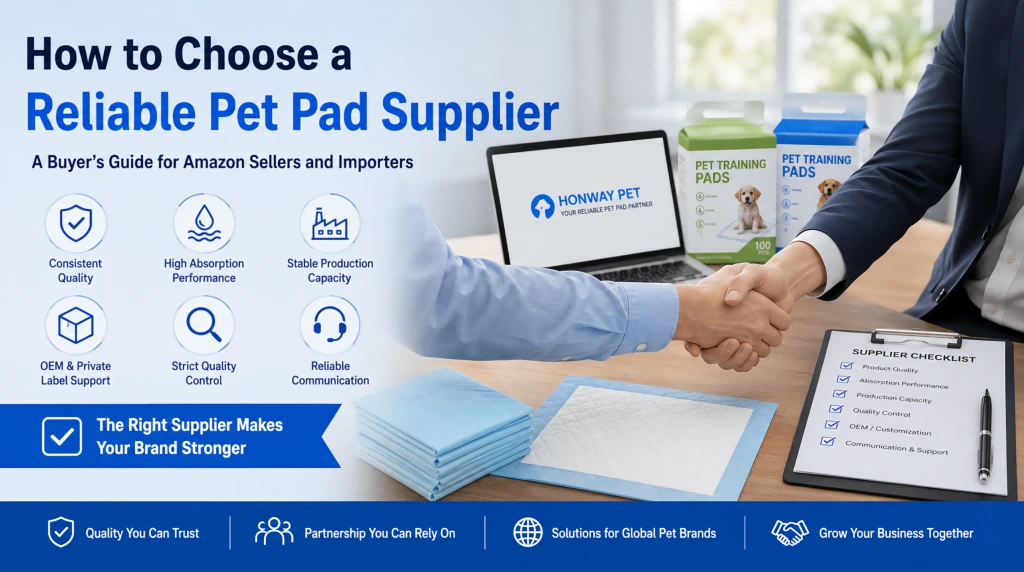
Pet pad supplier selection is about more than finding the lowest quotation. Amazon sellers, wholesalers, distributors, and importers need to evaluate product consistency, absorption performance, production capacity, quality control, OEM capability, and communication before placing a large order.
A supplier that can provide a good sample but cannot maintain the same quality during mass production can create much bigger costs later. For growing pet brands, the best supplier is not necessarily the cheapest one. It is the manufacturer that can consistently deliver the product customers expect while supporting the business as order volumes increase.
Quick Summary
- Check product quality and consistency rather than judging a supplier only by samples.
- Evaluate absorption performance instead of relying only on product weight or thickness.
- Confirm production capacity and supply stability before placing large orders.
- Ask how raw materials, production batches, finished products, and packaging are inspected.
- Make sure the supplier can provide OEM, ODM, and private-label solutions if your brand requires customization.
- Compare suppliers based on overall value, communication, and long-term reliability instead of unit price alone.
How to Choose a Reliable Pet Pad Supplier
A disposable pet training pad looks like a relatively simple product.
There is a top sheet, an absorbent core, a waterproof backing layer, and packaging. But anyone who has purchased pet pads in volume knows that small differences in materials and production can lead to noticeable differences in actual performance.
One batch may absorb quickly while another feels slower. Two pads may look almost identical but have different SAP distribution, absorbent core structures, edge sealing, or backing performance.
These differences matter even more for Amazon sellers because customer reviews can quickly expose inconsistent product quality.
For importers and private-label brands, choosing the right pet pad supplier should therefore be treated as a sourcing decision rather than simply a price comparison.
Here are the key areas worth checking before placing a bulk order.
1. Look Beyond the Sample and Check Product Consistency
A good sample is important, but it is only the beginning.
One common mistake buyers make is receiving an attractive sample, approving it, and then assuming that the mass-produced products will be exactly the same.
A professional supplier should be able to maintain consistent specifications throughout production.
When evaluating a supplier, ask about:
- Raw material consistency
- Pad dimensions and weight
- SAP and absorbent core structure
- Top-sheet quality
- PE backing performance
- Edge sealing
- Folding and packaging
- Batch-to-batch inspection
For Amazon sellers, consistency is particularly important.
Your customer does not purchase “Batch A” or “Batch B.” They purchase your brand. If the product performs differently from one order to the next, the customer usually blames the brand rather than the factory.
That is why a supplier’s production and quality-control process can be just as important as the sample itself.
2. Evaluate Absorption Performance, Not Just Product Weight
A heavier pet pad is not automatically a better pet pad.
The actual performance depends on how the materials work together.
The absorbent core typically combines materials such as fluff pulp and Super Absorbent Polymer (SAP). The distribution and structure of the absorbent core can affect how quickly liquid moves through the top sheet and how effectively moisture is retained.
When comparing suppliers, do not ask only:
“How many grams is the pad?”
Ask more useful questions:
- How quickly does it absorb?
- How evenly does the liquid spread?
- Does the surface remain reasonably dry after absorption?
- How well does the absorbent core retain liquid?
- Does the pad remain stable after absorbing moisture?
The right specification also depends on the target market.
A basic economy pad for high-volume retail does not necessarily need the same construction as a premium pad designed for larger dogs or frequent indoor use.
A capable pet pad supplier should be willing to discuss these differences instead of simply recommending the most expensive specification.
3. Check the Factory’s Production Capacity
Production capacity becomes especially important when your product starts selling.
A supplier may be perfectly capable of producing a few sample cartons. The real question is whether the factory can handle your regular orders when demand increases.
Before selecting a supplier, consider the following areas.
Production Capability
Can the factory support your expected order volume? Ask about available production lines, typical order quantities, and how production schedules are managed during busy periods.
Raw Material Supply
A stable supply of key materials is important for maintaining consistent production. Changes in raw material availability can affect both lead times and product specifications.
Production Scheduling
Ask the supplier to provide realistic lead times for samples, packaging preparation, production, and shipment.
Packaging Capacity
If you are building a private-label brand, the supplier should be able to coordinate product packaging, cartons, labels, and other customized requirements.
Scalability
If your Amazon sales double, can the supplier increase production without sacrificing product consistency?
This is particularly important for growing brands.
Changing suppliers after your product has already gained traction can be expensive. Packaging may need to be redesigned, samples need to be approved again, and customers may notice changes in the product.
It is often better to choose a supplier that can grow with your business from the beginning.
4. Ask How Quality Control Is Managed
“Good quality” is easy for a supplier to promise.
The more useful question is:
How is quality checked?
A reliable pet pad manufacturer should have quality checks throughout the production process rather than relying entirely on a final visual inspection.
Depending on the product and production requirements, buyers may want to discuss:
- Incoming raw material inspection
- Material weight and dimensions
- Absorbent core consistency
- Product size
- Absorption performance
- Leakage protection
- Edge sealing
- Folding accuracy
- Packaging quantity
- Finished-product inspection
For private-label customers, it is also worth confirming that the supplier can follow your approved product specifications.
If you have a specific pad size, packaging count, absorbency requirement, or material structure, those details should be clearly defined before mass production begins.
The goal is simple: the product approved by the buyer should be the product manufactured at scale.
5. Check Whether the Supplier Can Support OEM and Private Label
Many Amazon sellers are not looking for a generic puppy pad.
They are building a brand.
That changes the sourcing requirements.
A useful OEM pet pad supplier should be able to discuss customization options such as:
- Pad size
- Product weight
- Absorbency level
- Packaging quantity
- Printed packaging
- Private-label branding
- Scented options
- Charcoal odor-control options
- Other product specifications
For example, one brand may want a basic everyday training pad positioned around value.
Another may want a premium product with odor control, while another may be interested in scented pet training pads.
The manufacturing partner needs to understand these differences.
OEM is therefore not simply putting a logo on a package. Good OEM cooperation starts with matching the product structure to the brand’s target customer and price positioning.
6. Don’t Choose a Supplier Based Only on Price
Price will always matter in B2B purchasing.
But the lowest quotation does not necessarily mean the lowest total cost.
Imagine two suppliers.
Supplier A offers a lower unit price but has inconsistent quality.
Supplier B costs slightly more but provides stable production, better communication, reliable packaging, and consistent product performance.
If Supplier A creates customer complaints, returns, negative reviews, or delayed shipments, the apparent price advantage can disappear quickly.
For Amazon sellers, the cost of a poor product can extend beyond the purchase order.
It can affect:
- Customer reviews
- Product ratings
- Return rates
- Advertising performance
- Brand reputation
- Repeat purchases
A better approach is to compare total sourcing value, not simply unit price.
7. Test Communication Before Placing a Large Order
This is one of the easiest things for buyers to overlook.
You can learn a surprising amount about a supplier before signing a large purchase order.
Pay attention to how the supplier responds to technical questions.
Do they understand the difference between SAP content and total product weight?
Can they explain the available pad structures?
Can they discuss packaging specifications clearly?
Can they provide samples?
Do they answer questions directly?
Can they communicate realistic production and shipping schedules?
A factory does not have to agree with every request. In fact, a good manufacturer may tell you when a specification is impractical or unnecessarily expensive.
That kind of communication can be more valuable than simply receiving a low quotation.
8. Make Sure the Supplier Understands Your Target Market
A pet pad designed for a discount retailer may not be the right product for a premium Amazon brand.
Before requesting a quotation, define your market.
| Target Market | Possible Priority |
|---|---|
| Amazon value brand | Competitive cost and reliable basic performance |
| Premium pet brand | Absorption, comfort, and packaging |
| Multi-pet households | Higher absorption and odor control |
| Pet stores | Product differentiation and retail packaging |
| Wholesale distributor | Stable supply and competitive pricing |
| Private-label brand | Customization, packaging, and consistency |
A good pet pad supplier should be able to discuss these differences with you.
This is where supplier experience becomes useful. Instead of simply selling whatever is already available, the manufacturer can help you select a specification that makes sense for your market.
9. Request Samples Before Confirming Bulk Production
Never rely entirely on product photos or a specification sheet.
Request samples and evaluate the actual product.
Depending on your business, you may want to check:
- Overall dimensions
- Folding
- Top-sheet feel
- Absorption speed
- Liquid retention
- Backing performance
- Edge sealing
- Packaging
- Product consistency
If possible, compare samples from several suppliers using the same testing method.
This gives you a much clearer picture than comparing quotations alone.
For private-label products, it is also a good idea to approve the final packaging artwork and product specification before mass production begins.
Why Honway Pet Can Be a Long-Term Manufacturing Partner
For global pet brands, sourcing is not only about finding a factory that can produce pet pads.
It is about finding a manufacturing partner that can support the business beyond the first order.
Honway Pet focuses on disposable pet hygiene products and provides solutions for wholesale, OEM, and private-label customers.
Our product range includes standard disposable pet training pads as well as differentiated options such as scented pet training pads and charcoal odor-control pet pads.
We also support customized product specifications and private-label packaging for customers developing their own pet product brands.
For buyers, the objective is straightforward:
Consistent products, dependable production, and a supplier that understands long-term cooperation.
If you are looking for a pet pad supplier for wholesale, OEM, or private-label projects, Honway Pet can provide product development and manufacturing solutions for different market requirements.
Contact us for samples, product specifications, and OEM cooperation.
Website: https://www.honwaypet.com/
Email: marketing@honwaypet.com
FAQ: Choosing a Pet Pad Supplier
What should I look for in a pet pad supplier?
Start with product consistency, absorption performance, production capacity, quality control, OEM capability, and communication. Price should be considered together with these factors rather than evaluated on its own.
How do I compare samples from different pet pad suppliers?
Use the same testing conditions for each sample. Compare size, weight, absorption speed, liquid retention, leakage protection, surface performance, folding, and packaging.
Is a heavier pet pad always better?
No. Total weight alone does not determine performance. Material composition, absorbent core structure, SAP distribution, and overall product design also affect how a pad performs.
Can pet pad suppliers provide private-label packaging?
Many OEM manufacturers can provide private-label packaging. Buyers should confirm available packaging formats, printing options, minimum order quantities, artwork requirements, and production lead times before placing an order.
What is the difference between a pet pad manufacturer and a trading company?
A manufacturer controls or directly manages production, while a trading company may source products from different factories. For long-term OEM projects, buyers often benefit from working directly with a manufacturer because communication and product development can be more direct.
Should Amazon sellers choose a China pet pad supplier?
China has a large manufacturing base for disposable hygiene products, but location alone does not guarantee quality. Amazon sellers should evaluate each supplier’s actual production capability, quality system, product consistency, communication, and OEM experience.
Final Thoughts
Finding the right pet pad supplier takes more than comparing five quotations in a spreadsheet.
For Amazon sellers, importers, distributors, and private-label brands, the real questions are:
- Can the supplier make the product consistently?
- Can they maintain quality when order volumes increase?
- Can they customize the product around your market?
- Can they communicate clearly when problems arise?
- Can you see yourself working with them for the next several years?
A reliable supplier should be able to support more than your first shipment. The right manufacturing partner can become part of your product development and supply chain strategy as your brand grows.
If you are looking for a pet pad supplier for wholesale, OEM, or private-label projects, contact Honway Pet to discuss your requirements.