
Complete Guide to Disposable Pet Training Pads: Materials, Manufacturing, Quality Standards & Buying Guide
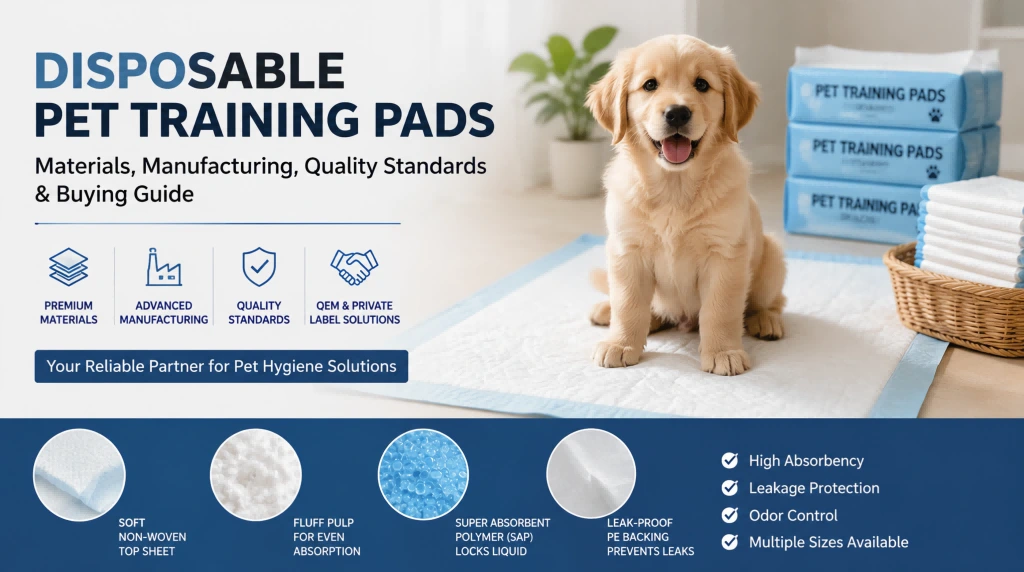
Table of Contents
1. What Are Disposable Pet Training Pads?
Disposable pet training pads, also known as puppy pads, pee pads, or dog training pads, are absorbent hygiene products designed to collect pet urine and keep indoor environments clean and dry.
They are commonly used for:
- Puppy house training
- Senior dogs with mobility issues
- Indoor pets living in apartments
- Pet daycare and boarding facilities
- Veterinary clinics
- Travel and transportation
A typical disposable pet pad consists of multiple functional layers:
- Top sheet: Soft non-woven fabric that allows liquid to pass through quickly
- Absorbent core: Contains fluff pulp and super absorbent polymer (SAP) to lock in moisture
- Bottom layer: Waterproof PE film to prevent leakage
- Adhesive edges: Help maintain the structure of the pad
Although pet pads look simple, their performance depends heavily on material selection, production technology, and quality control.
2. Why Disposable Pet Training Pads Are Growing in Popularity
The global pet industry has experienced significant changes in recent years. More households now consider pets as family members, leading to higher demand for convenient and hygienic pet care products.
Several factors are driving the growth of disposable pet training pads:
Urban Living and Apartment Pets
Many pet owners live in apartments where outdoor access is limited. Disposable pads provide a practical solution for daily pet hygiene.
Increasing Demand for Pet Convenience Products
Modern pet owners prefer products that save time while maintaining cleanliness. Disposable pads eliminate the need for washing and drying reusable alternatives.
Growth of Professional Pet Services
Pet hotels, grooming centers, veterinary clinics, and training facilities require reliable hygiene products in large quantities.
Expansion of Private Label Pet Brands
More retailers and pet companies are launching their own branded pet products, creating opportunities for OEM and customized pet pad manufacturing.
3. Types of Disposable Pet Training Pads
Not all pet pads are designed for the same market. Different customers require different specifications depending on usage scenarios and price positioning.
Standard Puppy Pads
The most common type used for everyday pet training.
Typical features:
- Multiple absorbent layers
- Standard SAP content
- Cost-effective design
- Suitable for household use
Heavy Duty Pet Training Pads
Designed for larger dogs or situations requiring higher absorption capacity.
Features may include:
- Higher SAP concentration
- Thicker absorbent core
- Improved leakage protection
Activated Carbon Pet Pads
Activated carbon layers help reduce unpleasant odors.
Commonly used for:
- Indoor environments
- Multi-pet households
- Premium product lines
Eco-Friendly Pet Pads
Developed for brands targeting sustainability-conscious consumers.
Possible materials include:
- Bamboo fiber
- Recycled packaging materials
- Biodegradable components
4. Materials Used in Pet Training Pads
The performance of a disposable pet pad depends largely on the materials inside.
Non-Woven Top Sheet
The top sheet is the first layer contacting liquid.
A high-quality top sheet should provide:
- Fast absorption speed
- Soft surface feeling
- Good liquid penetration
- Comfortable contact for pets
Common materials:
- PP non-woven fabric
- Hydrophilic treated non-woven fabric
Super Absorbent Polymer (SAP)
SAP is one of the most important components in modern pet pads.
Its function:
- Absorb large amounts of liquid
- Convert liquid into gel
- Reduce leakage risk
Higher SAP content generally improves absorption performance, but also increases production cost.
Manufacturers need to balance:
- Absorption capacity
- Product price
- Target market positioning
Fluff Pulp
Fluff pulp helps distribute liquid evenly throughout the absorbent core.
Its main functions:
- Improve liquid spreading
- Increase absorption speed
- Provide structure support
Waterproof PE Film
The bottom layer prevents urine from leaking onto floors.
A quality PE backing should provide:
- Strong waterproof performance
- Good flexibility
- Low noise during use
5. How Disposable Pet Training Pads Are Manufactured
Understanding the production process helps buyers evaluate supplier capability.
A professional pet pad manufacturing process usually includes:
Step 1: Raw Material Preparation
Materials are inspected before production:
- Non-woven fabric
- SAP
- Fluff pulp
- PE film
- Packaging materials
Step 2: Absorbent Core Formation
The production machine combines fluff pulp and SAP into an evenly distributed absorbent layer.
This step directly affects:
- Absorption speed
- Liquid retention
- Product consistency
Step 3: Layer Assembly
Different layers are combined:
Top sheet
↓
Absorbent core
↓
Waterproof backing
Advanced production lines ensure accurate alignment and stable quality.
Step 4: Cutting and Sealing
Large rolls are cut into individual pads.
Edge sealing helps:
- Maintain product shape
- Reduce leakage
- Improve appearance
Step 5: Packaging
Finished products are packed according to customer requirements:
- Retail packaging
- Bulk packaging
- Private label packaging
- Custom printed bags
6. Key Performance Factors of High-Quality Pet Pads
When buyers evaluate pet pads, several performance indicators matter.
Absorption Capacity
The pad should absorb urine quickly and prevent surface pooling.
Important factors:
- SAP quantity
- Core structure
- Material distribution
Leakage Protection
Leakage can damage customer experience and brand reputation.
Manufacturers improve leakage resistance through:
- Waterproof backing
- Sealed edges
- Optimized absorbent core design
Absorption Speed
Fast absorption helps keep the surface dry.
This is especially important for:
- Puppy training
- Multi-use situations
- Premium products
Odor Control
Odor reduction is increasingly important for indoor pet products.
Solutions include:
- Activated carbon layers
- Odor-control materials
- Improved absorbent technology
7. Pet Training Pad Size, Thickness, and Absorption Guide
Different markets require different product specifications.
Common sizes include:
| Size | Typical Usage |
|---|---|
| Small | Puppies and small pets |
| Medium | Daily household use |
| Large | Larger dogs and extended use |
| Extra Large | Professional facilities |
Thickness options:
- Economy pads: lower material usage, competitive pricing
- Standard pads: balanced performance and cost
- Premium pads: higher absorption and stronger protection
Choosing the correct specification depends on:
- Pet size
- Usage frequency
- Retail positioning
- Target customer expectations
8. Quality Standards and Testing for Pet Training Pads
Reliable manufacturers should have strict quality control systems.
Common testing procedures include:
Absorption Test
Measures:
- Total absorption capacity
- Absorption speed
- Liquid retention
Leakage Test
Checks waterproof performance under pressure.
Material Inspection
Incoming materials should be checked for:
- Thickness
- Weight
- Consistency
- Safety requirements
Packaging Inspection
Ensures:
- Correct labeling
- Product quantity accuracy
- Packaging durability
9. OEM and Private Label Pet Training Pads
Many pet brands choose OEM manufacturing to develop customized products.
A professional OEM supplier can support:
Product Customization
Options may include:
- Size
- Thickness
- SAP level
- Packaging design
- Printed bags
Private Label Production
Retailers can build their own pet hygiene brand without owning manufacturing facilities.
Advantages:
- Lower investment
- Faster market entry
- Flexible product development
10. How to Choose a Reliable Pet Pad Manufacturer
Selecting the right supplier is one of the most important decisions for buyers.
Consider the following factors:
Manufacturing Experience
Look for suppliers with:
- Long-term industry experience
- Stable production capability
- Professional engineering teams
Production Capacity
A reliable factory should support:
- Consistent supply
- Large-volume orders
- Seasonal demand changes
Quality Control System
Ask about:
- Raw material inspection
- Production monitoring
- Finished product testing
OEM Capability
A strong supplier should provide:
- Custom packaging
- Product development support
- Flexible order solutions
11. Common Mistakes When Purchasing Pet Training Pads
Choosing Only Based on Price
Low-cost products may use:
- Less SAP
- Lower-quality materials
- Weak packaging
This can create customer complaints.
Ignoring Production Capability
A supplier may provide samples but fail to maintain quality during large orders.
Always evaluate factory capability.
Not Considering Target Market
Different markets require different products.
A premium pet store and a discount retailer usually need different product positioning.
12. Future Trends in the Disposable Pet Hygiene Industry
The pet hygiene market continues to evolve.
Important trends include:
More Sustainable Materials
Brands are exploring:
- Eco-friendly fibers
- Reduced plastic packaging
- Sustainable production methods
Premium Pet Care Products
Consumers increasingly look for:
- Better odor control
- Higher absorption
- Improved comfort
Customized Private Label Products
More companies are creating unique pet brands through OEM manufacturing.
13. Conclusion: Choosing the Right Pet Pad Partner
Disposable pet training pads combine material technology, manufacturing expertise, and quality management.
For buyers, choosing the right supplier means looking beyond product price and evaluating:
- Manufacturing capability
- Material quality
- Quality control
- OEM support
- Long-term reliability
A professional pet pad manufacturer can help brands create products that meet market expectations and build customer trust.
At Honway Pet, we focus on providing reliable disposable pet hygiene solutions with manufacturing experience, customization capability, and quality-focused production processes.
Whether you need standard pet pads, OEM products, or private label solutions, choosing the right manufacturing partner is the first step toward building a successful pet care product line.